Dr. Carl Lavorata
A conversion-first implant website for an established Smithtown, NY practice.
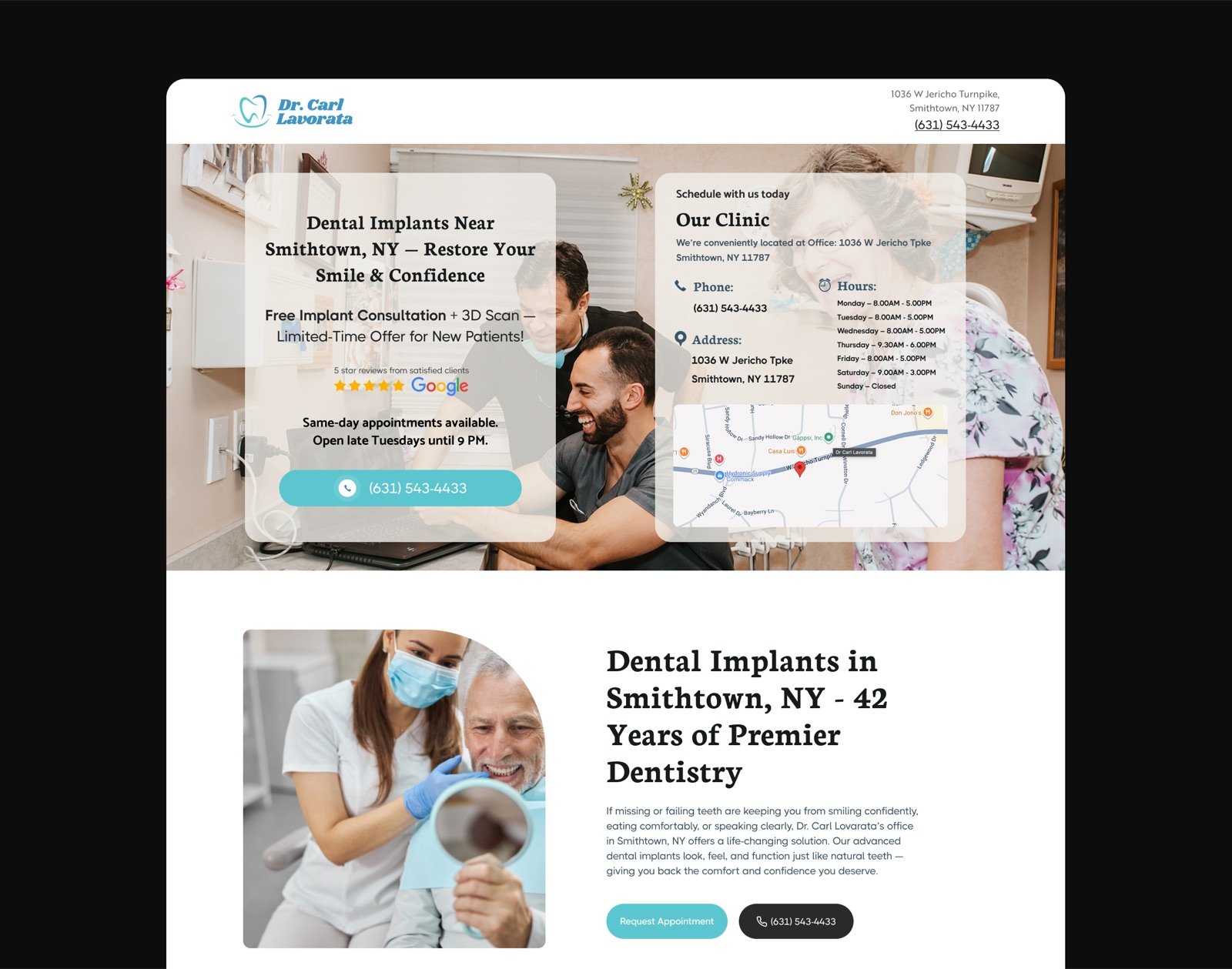
Dr. Carl Lavorata's practice has decades of implant experience in Smithtown, New York, but its online presence didn't reflect that authority. We designed a clean, trust-forward website that leads with a clear implant consultation offer, surfaces the practice's real Google reviews, and makes calling or getting directions a single tap, the actions a high-value implant patient actually takes.
- A focused hero built around a free implant consultation + 3D scan offer
- A prominent, always-visible click-to-call phone number for mobile searchers
- An embedded Google Map with one-tap directions to the Smithtown office
- A 5-star Google review trust strip to reinforce decades of local reputation
- A fast, mobile-first layout that puts booking within reach on every screen
The situation
Dr. Lavorata's practice had decades of implant experience in Smithtown, and almost none of it was visible to somebody arriving from a search result. This is the most common gap we see in established implant practices: the authority is real, built over many years of actual cases, and the website communicates roughly as much of it as a practice that opened last month. A reputation that exists only offline does nothing for a patient comparing three practices at eleven at night on a phone.
Implant patients also arrive with a narrow set of unanswered questions, and they arrive having already read something elsewhere. By the time they reach a practice website they are not asking whether implants are a good idea. They are asking whether this is the practice. That is a different job from the one a general dental homepage is built to do, and it needs different things on the page.
The decisions that mattered
Leading with a defined offer rather than a general invitation. A free consultation paired with a 3D scan gives the patient a concrete, low-commitment first step and a reason to act now instead of continuing to research. Implant enquiries stall on the size of the decision, and shrinking the first step is usually more effective than arguing harder for the treatment.
Making the phone number an action rather than a piece of information. High-value implant enquiries still arrive by phone far more often than by form, particularly from older patients, and a tappable number removes the last piece of friction between deciding and doing.
Putting the real Google reviews on the page instead of describing the reputation in body copy. The practice had earned genuine five-star feedback over many years. Restating that as a claim is weak. Showing the rating alongside its source is not, because the patient can go and check it.
Embedding the map. For a local practice this answers a question every patient has, and it quietly signals that the practice is established and physically real, which matters more for a surgical treatment than for a cleaning.
What to take from this
The pattern generalises to most established implant practices. If your practice has more experience than your website communicates, the fix is rarely more copy about the experience. It is proof the patient can verify independently, a first step small enough to take tonight, and a way to act on that step in a single tap. Those three things move implant enquiries more reliably than a redesign on its own ever does.
What we would do next
A website is the part of implant marketing that can be finished. The rest of it is ongoing, and for a practice in this position the next moves are usually the same three.
The first is separating the implant treatments into their own pages. Single-tooth replacement, multiple implants, and full-arch restoration are different decisions at very different price points, and a patient researching full-arch has questions that a general implant page cannot answer without becoming unreadable. Splitting them lets each page rank for its own searches and answer its own patient properly.
The second is paid search on a tight radius. Implant terms are expensive, and the case values justify the cost, but only where the targeting reflects how far a patient will realistically travel for surgical treatment. That is a smaller area than most practices assume, and Suffolk County geography makes it smaller still.
The third is capturing cases as they happen. Consent-cleared before and after photography, with the treatment and the timeline recorded at the time, compounds into the single most persuasive asset an implant practice can own. Practices that start this late spend years catching up to where they could already have been.
Tell us about your practice
Grab a slot on the calendar for the fastest path to a booked call, or send a few details and we'll follow up personally.